Tommy
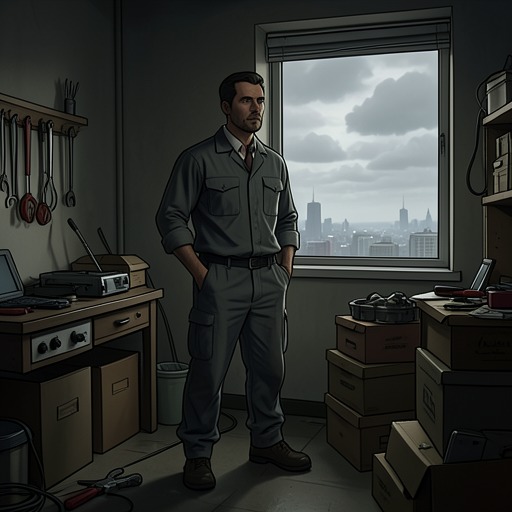
The Minds of Billy MilliganTommy is a sixteen-year-old personality of William Stanley Milligan, distinguished by his talent for electronics, saxophone, and landscape painting, and by an almost methodical commitment to escape. Often mistaken for Allen, he is described as belligerent and antisocial, yet his ingenuity is not simply destructive: the rules governing his abilities direct them toward escape rather than theft. Across the book, that combination of technical curiosity, guardedness, creative work, and vulnerability makes him both a practical problem-solver and a personality whose strengths remain entangled with fear and internal control.
Identity and Abilities
Tommy’s profile gives him muddy-blond hair and amber-brown eyes and identifies him as the escape artist. His resemblance to Allen is close enough that others often confuse them, although Gary Schweickart, impressed during an encounter, asks whether he is Tommy. The question points to a recurring complication of the group’s outward identity: Tommy is distinct to the inner system, but people outside it may mistake one personality for another.
His skills span several kinds of making. He plays the saxophone, specializes in electronics, repairs appliances, and paints landscapes. These are not merely labels in his profile; they become practical pursuits at different points in the narrative. Electronics gives him a way to investigate how things work, painting becomes both an outlet and a source of income, and escape techniques develop into a disciplined body of knowledge. His belligerence, meanwhile, is treated as something to manage rather than as the whole of his character. The internal rules allow him to use it when dealing with other people if necessary, while requiring him to control it.
Curiosity and the Discipline of Escape
Tommy’s escape practice begins in the same spirit as his mechanical investigations: he studies the constraints around him and asks how they can be overcome. When he wakes to find a loose light bulb and receives a shock while handling its metal collar, he traces the problem outward—from the lampshade and cord to the wall outlet, then to the wiring, fuse box, and lines leading toward the telephone poles. The episode shows his habit of following a physical problem through its connections rather than accepting the first explanation. An ordinary household fitting becomes the start of an investigation into the electrical system around him.
He also studies escape artists, reading about Houdini and Sylvester. Learning that some celebrated escapes depended on tricks disappoints him, but it does not end the project; instead, he turns toward a problem he can examine himself. Reading about African monkey traps, in which an animal becomes caught by refusing to release food through a narrow opening, leads him to study the structure of the human hand. He consults encyclopedia illustrations of bones, measures his hands and wrists, and exercises to compress his hands smaller than his wrists. To Tommy, the result is a dependable principle: if his hands can pass through a restraint, ropes and harnesses need not hold him.
That principle becomes a continuing practice. He fixes appliances in his spare time while refining his ability to undo knots and slip free of ropes. He buys handcuffs and trains himself to open them with a split plastic ballpoint-pen cap. From this practice he draws a practical precaution: carry two handcuff keys, in separate pockets, so at least one remains reachable regardless of how the cuffs are applied. Escape, for him, is not an abstract fascination. It is a sequence of problems, tools, rehearsals, and contingency plans.
The book also distinguishes technical escape from physical confrontation. When a rock strikes him, Tommy rapidly recognizes that he needs another kind of escape, one requiring strength rather than lock-picking or rope work. The moment marks the limits of a skill set built around restraints and mechanisms: not every threat can be solved by the same technique. Later, when Frank knocks Tony Vito from a bunk, Tommy moves quickly after Frank walks away, taps him on the shoulder, and strikes him when he turns. The action shows that Tommy can answer an immediate threat directly, but it sits beside the internal instruction that his belligerence should be controlled and used only when necessary.
Allen, Fear, and Internal Limits
Because Allen and Tommy are the personalities considered most alike, they are chosen to undergo fusion first. Their work with Dr. George Harding follows hours of argument and analysis and further internal discussion with Arthur and Ragen. Similarity does not make the process easy. Tommy has fears that Allen does not share, and the treatment brings one such fear into focus through baseball.
Allen loves the game; Tommy avoids playing because, when he was younger, he made mistakes at second base and was beaten for them. The contrast makes their apparent likeness incomplete. The same activity that is pleasurable to Allen carries the memory of punishment for Tommy. Dr. George Harding suggests that Nick Cicco, Allen, and others help by talking with Tommy about the fear and encouraging him to play. Art therapy is also to continue, including oil painting. The proposed approach addresses Tommy through both relationship and practice: reassurance from others is paired with a creative activity he already values.
A later musical scene registers the unevenness of fusion without reducing it to failure. In the music building on a Wednesday evening in June, Rosalie Drake hears Tommy playing drums, an instrument only Allen had played before. In the fused state, Tommy is plainly not as good as Allen had been alone. The scene makes a concrete cost of combination visible: the fused ability does not simply preserve the strongest performance of either personality. Fusion changes what can be done, and the result may be less proficient in a particular skill even as the personalities work toward a shared state.
Tommy’s relationship with internal authority also shapes what he can express. When Arthur blames Marlene for confusion and insists that the relationship end, Tommy wants to protest because he has fallen in love with her. Fear of Arthur keeps him from speaking. He knows he has come close to the boundary of being classed as undesirable, and that danger further limits his ability to defend the relationship. The scene places affection beside self-protection: Tommy’s silence does not mean he feels nothing; it shows how strongly the internal rules and Arthur’s authority constrain what he can say.
Work, Art, and Relationships
At a flower shop in Lancaster, Allen gets a job, but different personalities contribute in different ways. Timothy, who loves flowers, does most of the work, while Adalana sometimes appears to arrange them. Allen persuades the owner to display his paintings in the window, with the understanding that he will receive a commission if one sells. The plan appeals to Tommy as an opportunity to make money through his art. After the first paintings sell, he works harder, reinvesting some of the proceeds in paints and brushes. He produces dozens of landscapes, which sell faster than Allen’s portraits or Danny’s still lifes. The shop thus becomes a setting where the personalities’ distinct abilities have practical economic consequences, and where Tommy’s painting is recognized by buyers as well as valued internally.
His attachment to Marlene continues to surface under conditions that make it difficult to maintain. While Tommy writes her a letter, the handwriting changes and Philip takes over the message, redirecting it toward his own demand. The interruption matters because it turns a personal letter into evidence of how little control Tommy may have over communication once another personality takes the place. His affection is real within the episode, but the letter cannot remain wholly his.
Painting remains important in institutional settings as well. At Lebanon, graphic-arts materials from a project at Chillicothe Correctional Facility have been sent to the institution. Bob Reinert helps Tommy set up an easel and gives him permission to paint. Later, at the Dayton Forensic Center, superintendent Allen Vogel is sympathetic to William Stanley Milligan’s needs and permits oil painting; Tommy and Allen request art supplies. Security staff overrule the permission, arguing that linseed oil could be dangerous, and the supplies are removed. The contrast is sharp: painting had been encouraged as therapy and had earned money at the flower shop, but institutional security could still prevent its continuation.
Public Identity and Later Course
Tommy’s relation to the name William Stanley Milligan appears directly when Tony Vito asks his name. Tommy answers that people call him Billy Milligan. The response places his personality identity alongside the name used in the outside world, rather than treating the two as interchangeable in every setting. Later, when William Stanley Milligan is called to the witness stand and asked his name under oath, he answers Tommy. He explains that Allen wrote a letter intended to dissuade another patient from killing Dr. Lindner, and that the letter opposed shooting someone simply for testifying in court. Tommy’s testimony therefore identifies who is present while also clarifying the purpose of Allen’s writing.
The prospect of an interview with a writer provides another instance of the system deciding who should take the spot. William Stanley Milligan spends the night excited and frightened at the prospect of speaking to an author whose book had become a film. By dawn, Arthur judges him incapable of handling the interview and assigns the spot to Allen. Tommy is not named as the replacement, but the episode belongs to the same pattern that defines his life: access to the outside world is mediated by internal decisions, and the personality who feels or acts is not always the one permitted to speak.
Tommy’s practical independence also coexists with gaps in his awareness. In a bank, he looks around without knowing why he is there, sees nearly two hundred dollars in his wallet, and reasons that he must be leaving. Through the window he recognizes his mother and Marlene waiting in the car, with Kathy at the wheel. Checking the calendar on the teller’s counter, he realizes that this is the day he has been set free. The scene gives release an oddly indirect arrival: Tommy works out the occasion from the money, the people outside, and the date, rather than beginning with an intact recollection of how he got there.
Afterward, his technical interest turns toward a telephone blue box intended for John Wymer’s car, with the aim of bugging it. This project complicates the neat boundary established by the internal rules, which direct Tommy’s knowledge of locks and vaults toward escape and forbid him to help anyone steal. His ingenuity can be put to uses beyond the rule’s stated purpose, so the distinction between a skill and its application remains consequential.
In later hospital scenes, Tommy continues to paint landscapes. William Stanley Milligan brings two canvases to a conference room: one is an unfinished, unsigned night scene with black trees, a dark-blue sky, a black barn, and a curving path; the other is a richly colored landscape signed Tommy. The contrast preserves the visibility of separate artistic identities without requiring an explanation of the unsigned painting. The continuing landscapes also connect the later hospital period to the earlier flower-shop work, where Tommy’s pictures sold in greater numbers than the other styles described.
The book closes this thread not with a single resolution but with the personalities’ different activities still legible. Tommy paints landscapes, Danny paints still lifes, and Allen paints portraits while recording experiences at Lima, Dayton, and Columbus. At the same time, a hospital visitor reports that Tommy said Arthur had given up hope of treatment and cure and decided to commit suicide. Tommy remains an active painter and a messenger about the inner group, even as this report introduces a grave change in Arthur’s outlook. His arc therefore resists a simple portrait of the escape artist as pure freedom: he can master restraints, build a livelihood through art, and speak publicly as Tommy, yet affection, memory, institutional restrictions, and the group’s internal authority continue to shape what freedom permits.